
Redefining Pneumoperitoneum
We’ve re-engineered the familiar to solve the most critical challenge of laparoscopic entry.
VeressPLUS
Lightining fast
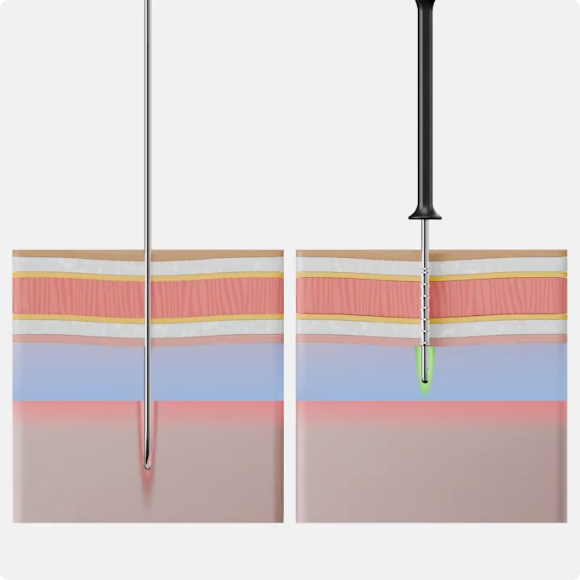
A 160 millisecond response in perfect harmony with your hands.The patented ADM Mechanism activates instantly the moment the needle tip enters the peritoneal space, minimising unintended overshooting and its associated risks.
Extraordinary performance

95% vs 5%
In Preclinical studies Participants achieved the optimal insertion depth (10 mm) 95% of the time, a dramatic leap from the 5% achieved by existing Veress needles.
Read more →
The Science of Precision
Safe abdominal entry is a cornerstone of minimally invasive surgery, yet it remains a step with inherent risks. Conversations with surgeons worldwide have highlighted the need for a more precise language to describe needle advancement. Specifically, two concepts are critical: Optimal Insertion Depth and Overshooting.
Optimal Insertion Depth (OID):
This is the point at which the Veress needle tip enters the peritoneal cavity and allows effective insufflation. OID should not be misconstrued as a “safe depth,” but rather understood as the minimum and necessary depth required to establish pneumoperitoneum. Beyond this depth, no further advancement is required, any additional penetration only increases risk without clinical benefit. Importantly, OID helps reduce excessive penetration but does not eliminate the intrinsic hazards of entry.
A structured survey of 365 surgeons within the European Association for Endoscopic Surgery (EAES) identified 10 mm as the reference OID.
Overshooting:
Overshooting occurs when the Veress needle advances beyond the Optimal Insertion Depth after peritoneal entry. This unintended motion confers no advantage and instead raises the risk of visceral or vascular injury.

Accelerated proficiency

VeressPLUS
Seamless adoption
Preclinical evaluations show that, VeressPLUS requires virtually no learning curve. From the very first use, surgeons can achieve safe and reproducible insertion depths, enabling consistent performance every time.
VeressPLUS
Designed for a good start
Engineered to minimize overshooting and its associated complications, the VeressPLUS provides the peace of mind you need to focus on your patient.
Expression of interest:
A call to collaboration
Our vision is built on collaboration. We believe that the most impactful innovations are born from a partnership with the surgeons who will use them. Your feedback and expertise are our most valuable assets. We invite you to partner with us in our mission.
Publications
Trust is not built on claims; it’s built on validated data. At ProVinci, our commitment to surgical safety is backed by rigorous, peer-reviewed research. We invite you to explore the scientific foundation of the VeressPLUS through our key publications, which you can access below.
1. A Novel Veress Needle Mechanism That Reduces Overshooting After Puncturing the Abdominal Wall
Postema R. R., Cefai D., van Straten B., Miedema R., Hardjo L. L., Dankelman J., Nickel F., Horeman-Franse T.
Published in: Surgical Endoscopy (2021)
2. Pre-Clinical Evaluation of the New VeressPLUS Needle Safety Mechanism on Thiel-Embalmed Bodies: A Controlled Crossover Study
Postema R. R., Dankelman J., Camenzuli C., Calleja-Agius J., Hardon S., Jansen F.-W., Horeman-Franse T.
Published in: Annals of Medicine and Surgery (2023)
3. The Relevance of Reducing Veress Needle Overshooting
Horeman-Franse T., Postema R. R., Camenzuli C., Calleja-Agius J., Alvino L., Dankelman J., Nickel F.
Published in: Scientific Reports (2023)
4. Learning Curve Estimation and Insertion Depth in Veress Needle Insertion Using a Conventional Veress Needle and the VeressPLUS™ Needle
Horeman-Franse T., Postema R. R., Cefai D., Hardon S. F., Andrejevic P., Dankelman J., Calleja-Agius J., Camenzuli C.
Published in: Surgical Endoscopy (E-pub ahead of print, 2025)